
– Lindsay Gould, Music Coordinator
Luke Steele, one half of the electronic duo Empire of the Sun, talks the blues, the importance of visual identity, and the future of music. During the conversation, Steele also reflects on the creative partnership behind Empire of the Sun, the inspiration for the band’s latest album Ask That God, and what it’s been like to see songs connect with younger generations through social media.
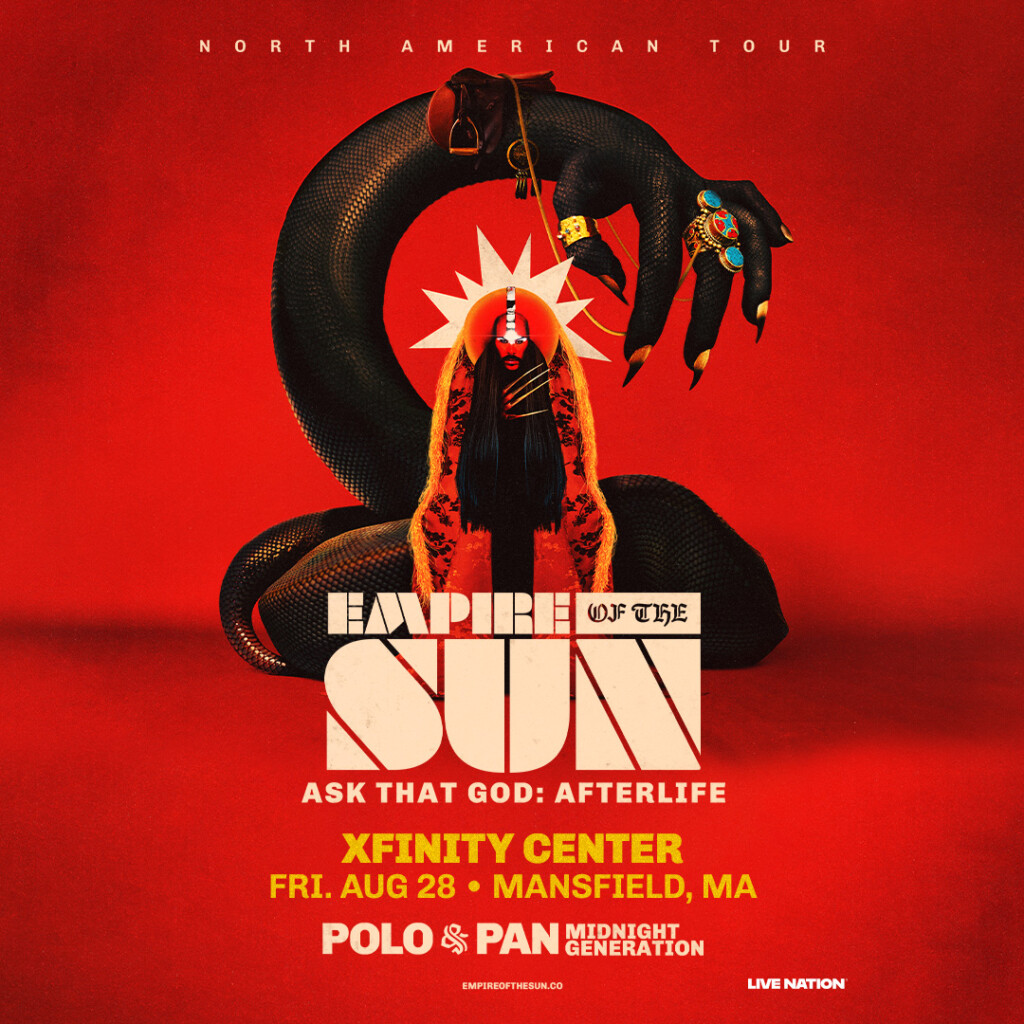
Empire of the Sun will hit the road this summer and are set to perform at the Xfinity Center in Mansfield, on Aug. 28.
Lindsay: I’d love to know some of your earliest musical influences or experiences that shaped you before starting Empire of the Sun, or even before The Sleepy Jackson?
Luke: I think what I was so interested in about Empire is that we come from two different worlds. Nick came from this underground rave world, where he was deep into Ministry and Underworld and all this deep house stuff. And, well, I came from the blues world, which is more J.J. Cale, Stevie Ray Vaughan. My father was a blues musician, so I grew up in the blues club that he ran. That shaped me a lot. There were certain nights at the club where he’d just go, “My son’s out there. He’s gonna get up and play some blues for us,” and he’d call me out. I sort of cut my teeth in a blues club. That influenced my love for the blues, but also songwriting. He’d always say, “You’ve got three minutes to tell the world what you’re talking about.”
Lindsay: That’s great. I mean, Empire has been together for so long now, nearly two decades. You’ve gone through different eras and breaks between albums, but you guys always seem to come back together. Why do you think the two of you continue finding your way back to this project?
Luke: It’s funny, I was thinking about this because it’s like a marriage. You know, you get married and then people always go, “That’s it. I’m done. I’m leaving.” Then they go somewhere else and realize, “I kind of liked her. I like that my wife would make these stupid jokes or make mashed potatoes with too much butter.” I think that’s like the chemistry of a band. When we first met, there was a unique kind of chemistry.
Lindsay: Absolutely.
Luke: The chemistry is unique, and it’s symbiotic. At some point, you both realize that you’re greater together. It’s like two is better than one because when one falls down, the other’s there to help them up. In 2020, when the pandemic hit, I bought this log cabin in Northern California. I was like, “That’s it. The band is over.” I moved there and made a solo record. It was great and something that I needed to do. It was really liberating to do everything and mix everything myself. But then I realized, “Wow, there’s nothing like working with my bandmate.”
Lindsay: I feel like a lot of bands break up and then they’ll do solo music and never speak to each other again. But I think it’s nice that you found balance. You can appreciate that the solo album is what you needed, but also, at the same time, appreciate your partnership.
Luke: Yeah, exactly. It’s so important to step away and step out of the storm.
Lindsay: Especially during COVID. I feel like everyone just needed to find themselves.
Luke: Yeah, it’s just so much like a marriage. I tell people to just go somewhere else in the world and see how other things operate and live. I think we do that. We take time, we make records, and then we disappear for six months. When we come back, it’s 30 seconds of small talk: “How’s your wife?” “She’s good.” “Okay, so I’ve got this great chord.”
Lindsay: Definitely. I think one thing that fascinates me most about Empire is the dedication to detail your visuals. I feel like a lot of artists focus solely on the music, which is important, but there’s so much more to being an artist in today’s industry. There’s kind of this personal mythology you’ve created, and you’ve spent a lot of time building a really distinct sense of identity. When did you realize the visuals needed to be just as important as the music itself?
Luke: It’s just so important. We’ve been given these beautiful eyes, and I always use this quote that Chet Atkins, the great guitarist, said: “People hear with their eyes.” It’s so true. People see something like a peacock and its feathers, and it’s like, “Wow, what is this animal?” Before Nick and I got together, there’d be guitar bands. We both came out of art school, and you just wanted to look drab and grungy. You wanted to look like you were part of the wallpaper or like a roughed-up poster that’s blown in from the street. Let’s follow our forefathers like David Bowie and Prince. The way you look and appear is half of the whole project, really.
Lindsay: Absolutely.
Luke: It’s funny. Yesterday I was driving in Santa Monica, and the car in front of me had this bumper sticker, and it said, “Don’t be scared of colors.” I just thought that was so cool.
Lindsay: That’s a great bumper sticker.
Luke: It’s just that color is so beautiful, and they’re discovering more and more Pantones and colors. They’re still discovering new insects and animals. It’s really fascinating. When I was in art school, I was like, “Well, Prince has got purple. I’m gonna claim blue.” For years, Voyager Blue was the Empire color, and then just recently, on the Ask That God tour, it was like, man, the world is in a state of battle. We’re not just in a physical battle, but we’re in a deep spiritual battle in the world. So red is the color that I see, and this whole tour has been the color red — the battle color.
Lindsay: I would love to talk a little bit more about the Ask That God album and kind of where that name comes from and the concept behind it.
Luke: I was thinking about something along those lines when we were shooting all the videos. I feel it more now, but I feel like we’re stepping into the unknown. There are meteors falling out of the sky in different countries. There was one in Australia, and there was one yesterday in America, in Kentucky. The viruses are getting stronger, and no one knows. You look at who’s running the country, and it’s like they’re running McDonald’s — it’s the clown show. The one who knows, and who we have to trust, is the HeavenlyFather. We just have to ask God. That’s sort of where the title came from. Obviously, post-pandemic, what a polarizing time for the whole world. With everyone locked away, it was just time to ask the Father, “What are we meant to do?”
Lindsay: Yeah, that’s great. That album came out in 2024, and I see you guys are going on an “Afterlife” tour. I want to ask: Why extend the Ask That God era and continue to explore that world of music?
Luke: We can’t keep doing the same show, so it is still part of the Ask That God era, but we’re only human, so we can only do so much. We’re deep into the next record, but records take so long. We have over 50 songs, and to finish them, mix them, master them, make videos, artwork, it’s a six- to eight-month process. So we wanted to keep part of the same world and extend into it. This is kind of like the final frontier. The emperor has to really get to the point where he trusts God. He’s going through all the trials and things happen: he falls down, he comes back up, but this is kind of the final frontier where things are more dramatic, heavier.
Lindsay: I feel like that really reflects everything that’s going on. The world is pushing toward a breaking point, and no one really knows what’s happening.
Luke: Yeah, it’s going to be wild, that’s for sure.
Lindsay: Earlier this year, I saw that you re-released “Alive” featuring some new remixes with different people. I’m really curious to know what goes through your mind when you’re looking to collaborate with someone.
Luke: The remixes are mainly guys that we dig just in the clubs making dope music. Collaboration is a whole other thing of serendipitous proportions. It’s kind of like you run into someone, then they say something else, and then you hit them up on Instagram. It’s always funny how things work. Some artists you hit up and they open the door, whereas others don’t.
Lindsay: You’d think people would take advantage of everything nowadays. There’s so much music out there, and it’s so easy to create something with AI or GarageBand. I feel like if you’re reached out to, you’ve got to take advantage of that.
Luke: Yeah, it’s kind of funny. I’m still a little bit shocked by the younger generation that they don’t reach out and say, “My band’s the best. We should be supporting you. How about it?” No one does that, but that’s me. That’s what I did. I’d be like, “Lindsey Buckingham, I love you, man” — greatest guitarist on the planet — “you want to collaborate?” And he said yes. I’ve done that with so many artists, and a lot of them don’t work because people are so busy or it’s not the right timing. You just have to try.
Lindsay: I feel like younger generations think it’s scary to take initiative. But I do understand that’s how you get what you want. That’s how you’re going to get to where you want to go, I guess.
Luke: Yeah, you’ve got to be courageous. Fortune favors the brave. I think you have to be so aware and tuned into the things God is putting in your path.
Lindsay: Speaking of younger generations, songs like “Walking on a Dream” and “We Are the People” are huge on TikTok and social media, getting their own afterlives by connecting with younger audiences. What’s it like to watch your music continuously be rediscovered by these new generations?
Luke: It’s just incredible. From day one, it feels like there’s been a lot of favor on this band. It’s been blessed. We spend a lot of time trying to make the songs feel like they’ll stand the test of time. We use amazing gear and try to make it as timeless as possible, try to make these generational songs. I guess that’s the proof when you see these young kids come in, especially during COVID, saying, “What’s this new band?” It’s a beautiful feeling. My daughter’s friends are all like 18, and it’s cool to see how the music’s trickled to this next generation. It’s the greatest compliment to see that younger generation really loving what we made.
Lindsay: I know you spend a lot of time thinking about your tour choreography and when to go into the crowd and interact with people. Have you noticed on tour that audiences have maybe gotten younger?
Luke: Every year the kids get younger and younger and younger. In some audiences now, it’s like we’re playing for the Swifties. It’s incredible to see this younger generation and to see what they’re making. It’s kind of fascinating how they’re using the tools and bending things. I think the future of music is kind of exciting, you know? Everyone’s scared of AI, but the guys who make AI and use it past the point of no return are the guys that don’t really understand the scope of the whole thing. They’ll be the ones to perform live, and it’ll just be a robot standing there, and no one gets it.
Lindsay: That’s what I think is so great about your music, too. You talk about making generational music, and I think people continuously coming back to it just proves that it’s stood the test of time. Years later, people are still inspired by it. I think that’s really special.
Luke: Yeah, we searched so long to find the heart of it. The robot doesn’t have a heart. The robot doesn’t love like a woman. That’s the big thing that’s missing from the robot. I think if artists just keep pushing into that feeling, to quote my own song, “it’s the feeling you get.” That’s everything.
Lindsay: We’ve spoken a little bit about tour, but you’re about to do this huge international run. After years of touring, from small venues to big venues to festivals, what keeps you excited and looking forward to touring, even after doing it for so long?
Luke: I think I’m so inspired now because I actually have a team that is so incredible. When you start, you have nothing. My wife and longtime collaborator has been my creative director, wardrobe designer, choreographer, animation show builder for 20 years. But now I have seamstresses, a creative director, visual artists, mixers. I have people, and I need it because the show’s so big now. It’s just so inspiring because I can send an idea, and people can sketch and reiterate things and bring it back to me. I can be a director, which has always been what I’ve wanted to become. In that position of a Spielberg or a Prince or something, where you can make stuff, but you have great artists around you that can be part of your team. We do shows and we film them, we change things. My guitarist always says, “You treat it like a piece of chewing gum.” You can flip a song, and it’s way better now, or it’s terrible, and I love that. With anything, like your health or your marriage, sometimes you just need to change one thing. I get inspired by that. It’s like, “Let’s just switch things up,” and I’m constantly doing that with fashion and the songs. It just keeps changing the chain reactions of creativity.
Lindsay: That’s really well said. Well, that’s about all I have for you. I want to thank you for your time. I really appreciate it.
Luke: Yeah, thank you, Lindsay. Good chatting.
Lindsay: Good luck on tour!
Luke: Thank you. See you soon.