
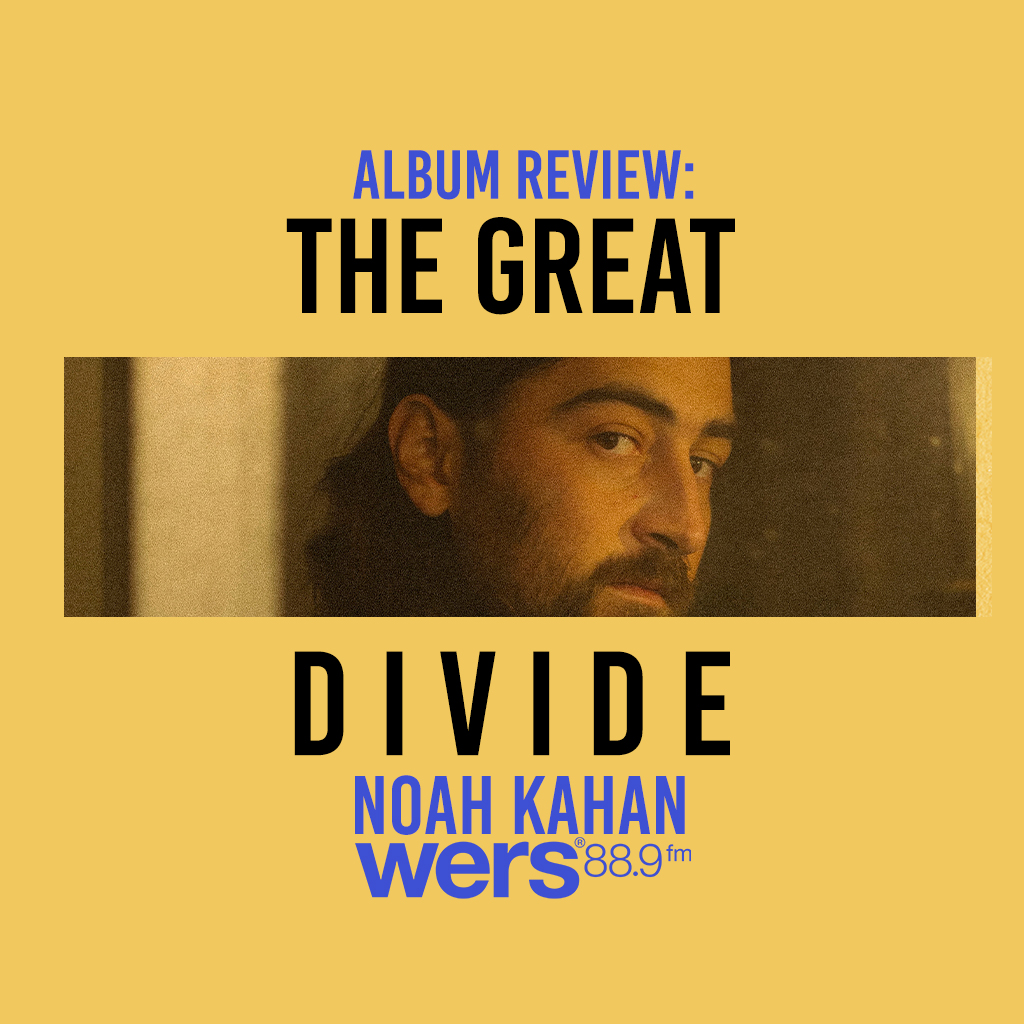
By Lindsay Gould, Music Coordinator
Artist: Noah Kahan
Favorite Track: “We Go Way Back”
For Fans Of: Mumford & Sons, Hozier, Lizzy McAlpine
A More Ambitious Form of Folk
There’s a moment, just before the sun disappears on a late August evening, when everything feels suspended. The air hums with crickets, the heat clings softly to your skin, and somewhere in the distance, a child is laughing like nothing will ever change. On his fourth studio album, The Great Divide, Noah Kahan doesn’t just describe that feeling, but he preserves it and captures it like an old home video.
At 17 tracks and just over an hour, The Great Divide arrives with the weather weight of something live-in. After the cultural phenomenon of “Stick Season,” the TikTok-born hit that turned a clip into a generational artist-defining album, Kahan could have easily played it safe. Instead, he goes inward, chasing an unflattering level of honesty.
Remembering the Past
The album opens with “End of August,” a song that feels like stepping into a childhood memory. The chirping of bugs crackles like static before giving way to a startling piano, a departure from Kahan’s familiar acoustic sound. “Everything you see will die,” he sings, not as a warning but as a fact already accepted. It’s existential, sure, but also oddly comforting. The song lingers in a fragile understanding that joy is fleeting precisely because it’s real. By the time he frames life as “a photo on the fridge,” he’s already done what he does best: shrinking the infinite into something achingly small and familiar.
That intimacy sang throughout the entire record. On “Downfall,” he leans into one of our most brutal instincts which is saying the thing you’re not supposed to admit out loud. The premise is simple, loving someone as they leave, but he complicates it with a reality that feels almost taboo. “I don’t mind being your dead end,” he confesses, before admitting he’s rooting for their plans to fail. It’s not noble, and it’s not kind. But it’s real in a way that cuts deeper than any polished heartbreak pop ballad. Kahan has always understood that longing isn’t always graceful; sometimes its petty, sometimes its petty.
“Paid Time Off,” which Kahan introduced as the album’s “happiest” track, drifts with an easy, almost country-leaning rhythm, but its core is anything but carefree. The title itself becomes slippery describing res as something earned, or withheld. Lyrics like “ I called you, but I’d run out of words” land with the dull slap of emotional burnout. When he darkly compares love to “a runnin’ car in a closed garage,” he reframes warmth as something suffocating to the point of death.
Real People, Real Memories
Kahan’s songwriting has always thrived on specificity, but here it feels sharper, more visceral. Nowhere is that clearer than “Staying Still,” a fan-favorite that was originally sung at a benefit concert back in November at MGM Music Hall at Fenway (and yes, I was lucky enough to be in attendance). Built around distinctly Boston imagery such as Logan Airport, the Charles River, Storrow Drive, and the Harvard track team, it’s geographically grounded and emotionally rich. ‘You could punch me in the gut,” he sings, “and it wouldn’t hurt like watchin’ you grow smaller on the back road.” It’s melodramatic in theory, but he sells it with such sincerity that it feels undeniable. Even its humor, wishing, half-seriously, for a tornado to take out Logan, lands not as a joke, but as desperation dressed up as the punchline.
That balance of wit and devastation is part of what makes The Great Divide so disarming. Kahan doesn’t just write sad songs; he writes deeply nuanced and complicated ones. “Haircut” takes what could’ve been a simple “returning home” narrative and flips it on its head. When he admits, “I tried to heal your wounds just to say I helped,” it feels like reckoning with his own stardom, and the uncomfortable possibility that even his kindness has become stale and manufactured. The song was written out of the fear of returning home after fame, uneasy about his small town’s perception of his newfound stardom. We also hear a different side of Kahan’s voice in “Haircut,” when listening you can hear the bitter contempt of a person treated as the fallback plan. Fame, in Kahan’s world, isn’t glamorous, but alienating, distorting, something that follows you like a shadow you can’t unrun.
That metaphorical shadow looms large over the album’s emotional peaks. “23” stands out not just for its subject, grappling with someone lost to addiction, but for how Kahan delivers it. Known more for his gentle restraint, he lets himself unravel here, his voice belting at full volume that feels almost too intimate to witness. The memories he conjures are painfully ordinary: learning how an engine works or standing side by side in the weight room. He’s not mourning the tragic loss of a friend lost to addiction, he’s mourning the everyday version of someone who no longer exists.
If “23” aches with longing, “Deny Deny Deny” burns with something closer to resentment. It’s one of the album’s more sonically upbeat tracks, but its lyrics seethe with exhaustion. Kahan paints a relationship defined by avoidance, but the refusal to acknowledge what’s broken. “I’m far too tired to watch you lie,” landing on the kind of resignation that feels worse than anger.
The Man, Not the Celebrity
And then there’s “We Go Way Back,” (my personal favorite) which feels like a deep exhale of crisp, fresh air. After an album spent wrestling with identity, memory, and the cost of leaving, Kahan lands somewhere unexpectedly gentle. The song trades ambition for domesticity, fame for anonymity. “I don’t need my name back,” he admits, sounding like he’s hoping to trade the pressure of fame for similar days. The production is soft and dreamy, feeling weightless, giving his voice room to settle into something resembling peaceful acceptance.
What makes The Great Divide so affecting isn’t just his voice or the production, but its his storytelling. It’s the way he understands memory, not as something fixed, but as something alive, always shifting and unreliable. These songs don’t just revisit the past; they reshape it in real time.
Kahan has always been good at making listeners feel seen, but here, he goes a step further. He makes you reflect on where you’ve been, who you’ve lost, and what you’ve outgrown. The Great Divide is a masterclass of heartbreak and nostalgia, shredding your heart to pieces then wishing to do it over and over again. By the time The Great Divide ends, it doesn’t feel like you’ve just listened to an album. It feels like you’ve returned from a distant memory, a place you didn’t realize you missed until you were already there.