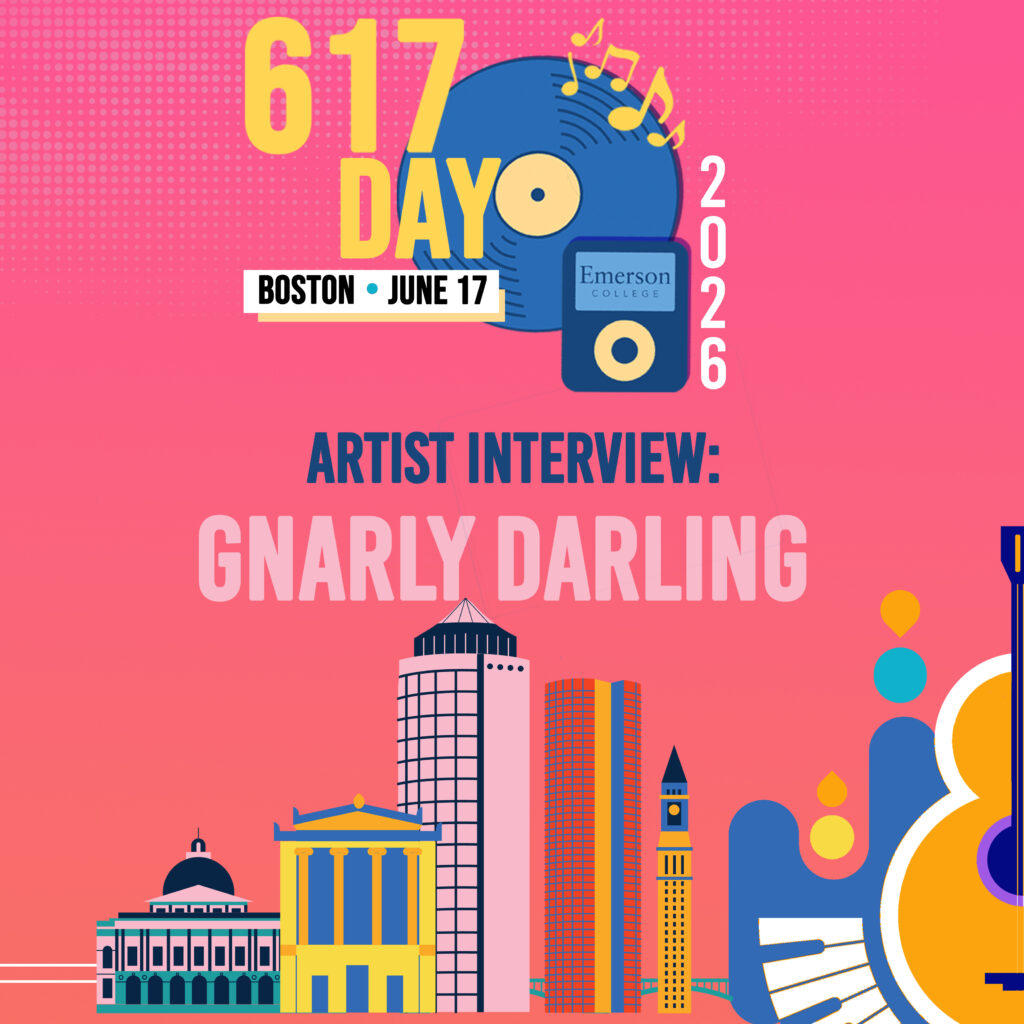
Ahead of 617 Day, a day in which WERS celebrates local talent and businesses, Web Service Coordinator, Fenton Wright, is sitting down with the artists performing to talk to them about what music and Boston means to them. Today we introduce you to a band led by teachers, Gnarly Darling!
Fenton: Just to get into it because I know 617 Day is coming up, which is kind of crazy. I was wondering kind of how you guys are feeling for the day?
Ryan: I think we’re excited. We’ve been, you know, rehearsing a lot. We’ve been working on some new material. We are actually going into the studio in July to record our second release. So we’re excited about that. We just feel like 617 Day is going to be a great opportunity to get out there and connect with great people, in an awesome setting and share some of our music with the world. So we’re psyched.
Gary: Yeah, that would be a ditto for me. Yeah, we are really, really excited to do this not only for the city, but for Emerson College.
Fenton: Because you’re [Gary] an Emerson alum, I was just wondering if you could talk about coming from Emerson to now being in Gnarly Darling? Take us through that journey.
Gary: Absolutely! First off, it is really a lot of fun to come back all these years later and be part of Emerson. But, you know, specifically, I’ve always loved the performing arts, and that’s one of the main reasons that attracted me to Emerson College, because that’s really what they specialize in. But ever since I was about three years old, I’ve always been involved in music. And so when you take a combination of music and performing arts together, you can take a lot of the experience you got from Emerson and the performing arts and put it toward how we perform musically, and that’s what’s really exciting.
Fenton: I wanted to ask you all about your music specifically. I want to know, how you would want to categorize it for someone who is trying to get acquainted to it or maybe hasn’t ever listened to it? I know when you go to streaming services and stuff like that, it might not be how you would want it to come across.
Ryan: It’s a great question. I think, you know, on the surface, a lot of people would probably categorize us as an Americana band. And I think that’s based primarily on the fact on our instrumentation. Right? We have acoustic guitar, Harmonica, and then our rhythm section with Gary on drums and our bass player, Eric. So strictly like when we think about the instruments. Americana comes to mind.
I think if you peel back the layers a little bit, I think, I think we bring in a lot of other influences as well. Jesse, one of our lead vocalists, has a really incredibly soulful voice. I think about Pete’s harmonica, which has kind of a bluesy sort of tinge to it at times. And in the songwriting, I think a lot of our songs have very sort of melodic hooks that maybe cross into a little bit of like pop at times as well. So I think it’s a mix, a lot of different things.
Gary: Yeah, I’ll agree. And I’ll also add that we’re unique. We truly have our own sound. And when people ask us, you know, “who do you sound like?” We sound like Gnarly Darling. I mean, we truly are unique.
And we’re also very family oriented. I mean, you can come and see us at a bar and have a few drinks. Or you could come see us play Ogunquit at the park and bring your family. We’re really that type of a band and that’s the type of music we play.
Fenton: Is that kind of inclusive environment almost like something you guys want to cultivate, right?
Ryan: Absolutely. Gary always says we’re not just a band, we’re a family. I do think that’s true. I think, um, the five members of the group, we are a cohesive unit. We love each other. We’ve got great relationships. We know each other’s families and spouses. I think a lot of that stems from how the band got started, uh, where we, you know, primarily a band of teachers. We started off working, um, you know, on music for some of our students at school assemblies. And as things kind of grew and developed and we got better as a band, we started playing out and then started working on original songs and recorded our first album. And so it’s grown into something much bigger. But it began from To use your words in a very inclusive place with a group of teachers.
Fenton: Because my mom was a teacher and I know how much seeing her students grow affected her. I kind of want to know the motivation behind becoming a teacher and going into public works like that. Because I know a lot of times it is that desire to be able to give back.
Ryan: Yeah, absolutely. I think, you know, for me, and, I think a lot of my bandmates would agree, you have an opportunity to impact the future when you’re an educator. There are a lot of things going on in the world that you have little control over. But when you’re working with kids and you’re helping them develop the skills that they’re going to need to to navigate the world, and you’re helping them develop the character to be good people and to want to contribute to the greater good of everyone. It feels like you’re actually doing something to affect change, which is a really, really powerful thing. And I think it gives us all a real strong sense of purpose.
Gary: Yeah. And I don’t know if you know this then, but everybody in the band except Gary Goodman is a teacher. Ryan is a middle school principal, but with an English major. Pete, our harmonica player, teaches history. Jesse graduated Berklee and teaches music, teaches voice. And Eric is the high school music director for the city of Dover. So everybody in this band except me as an educator. And quite frankly, I don’t think you really want me as an educator.
Fenton: I think it would be fine. I mean, if you know a lot of music you could do, like music history. For a while, I wanted to teach history, but I don’t think I’d be good in the classroom, so I don’t think that’s for me.
Gary: You definitely don’t want me as your teacher.
Fenton: I also wanted to know are there any kind of inspirations you draw from throughout music history?
Ryan: Yeah. I think, you know, there’s probably different answers. If you asked each of the five of us, you’d probably get a slightly different answer, whichI think is one of the things that’s special about us and makes us unique. Like Gary was saying, you know, we all, you know, share love of certain types of music, but we all have different things that we’re interested in as well. And so I think all of those influences come into play for me as the songwriter in the group. There are definitely people that I’m inspired by and I try to emulate as a songwriter.
One of my favorite parts of what we do as a band is, I will write a new song, it’s just me and my acoustic guitar. And then the best part for me is when I bring it to Gary and Jesse and Pete and Eric, and we start to work on it together, because it generally transitions and morphs into something very different from what I came up with when it was just me and my guitar. Gary adds some really interesting beats, or Pete’s got an incredible harp part, or Jesse does something with the lead vocals or with the harmonies. That just brings it to a different level. And so that collaborative aspect of it is really the most fun for me.
Fenton: Having a more bluegrass instrument based band, how do you kind of change that in sessions and things like that to get a unique sound?
Ryan: So Gary, I definitely want to hear what you have to say on this one. I mean, my initial thought, I think about something that, uh, our producer Brian said when we went into record our album, he said, “Whatever we do, it needs to be in service of the song.” I think that’s what Pete does. He doesn’t try to sort of force a particular style. I think he listens very thoughtfully to the new song, and then he tries to come up with a part that complements what other people in the band are doing, or maybe fits the mood of the lyrics in some way. If you listen to our debut album, which came out back in November, some songs you’ll hear have a little bit of an edge to them, and he might play something called Cross Harp, which kind of has more of a bluesy sound to it. And then there are other songs that are maybe a little folkier in nature, and so play a different style of harmonica on those. So I really think he focuses on, you know, sort of trying to meet the needs of the specific song that we’re working on.
Gary: Yeah, and I was just thinking about this as Ryan was talking. When you talk about being unique, but what makes it a lot of fun is the fact that we all don’t sit around and read sheet music or, you know, Ryan hands out sheet music because first off, I don’t read music, I play totally by ear. So a lot of times what happens is Ryan will send the group a new song that he put together. And all that will happen is he’ll say, “Bring your thoughts in.” And a lot of times what will happen is Ryan and I will meet about an hour before rehearsal so I can be somewhat creative on the drums, because if Ryan and I are somewhat in sync with our parts, then the bass player can listen to what I’m doing and form his own rhythmic sound. Jesse and Ryan because Ryan has the vocal part, so Jesse can link onto that. And then Pete kind of listens to everybody and then gets inspired by what everybody else is doing. So when I say, you know, unique, it truly is unique because we’re not playing off a sheet music. We’re playing from our heart, we’re playing from our soul. And and we’re playing music that just comes to our spirit. And that’s what truly makes our band so different and really have that mass appeal.
Fenton: Along the lines of that, the recording process of your album, how was that? I know the experience especially for a debut album, it could be interesting for different artists,
Ryan: What do you think, Gary?
Gary: You know, well, what we’ll do is once we know, we kind of we’re very democratic in this band. So nobody has the ultimate say except me, maybe. But no, nobody really has the ultimate say. So the first thing we’ll do is decide what songs we want to record, and everybody has to be in agreement, whether it’s five, eight, ten, however many songs. Then we’ll spend a good 1 to 2 months rehearsing, rehearsing, rehearsing, rehearsing to a click track so the timing is right, spot on. And then, to be honest, and I’m really not saying this to be funny or, you know, toot my own horn, but a big part of having a successful recording is having the drummer prepared, because the first day of recording typically is always the drums, and once the drums are down, then the beat is down and then everybody can add their part. So it’s really all about the preparation going in. And then also having a really good engineer and producer that, you know, again, without being insulting, gives us feedback, gives us really good pointers because they’ve been doing this for so long. That’s just my point of view. And I’ll let Ryan chat.
Ryan: I think that’s a great description, Gary. I think the other thing that was kind of fun to think about going in for the first time last year when we were putting together the first album is all of us had different levels of experience. You know, Gary’s been playing in bands and he’s recorded before. Eric and Jesse have. I had only recorded as a solo artist, which is a very, I think, different kind of experience. I don’t think Pete had ever been in a recording studio before. So we were all coming at it with different experiences and different perspectives, which I think allowed us to really, um, you know, have, um, fresh eyes, uh, fresh ears as we’re listening to things. I think that just added to that kind of collaboration that we really enjoy about being together in this band.
Fenton: So is there anything that I haven’t asked that you guys want to put out there?
Ryan: I think, you know one thing I always hope people will pay attention to about our band. There’s the music. And I think sometimes, um, like I said, we’ve got melodic songs. It can be a little bit hooky. And I think sometimes you just get into the melodies. I hope people pay attention to the lyrics, because we put a lot of time and energy into that. Not only me as the songwriter, but the whole group. I think people are really thoughtful. Gary, Jesse, Pete, Eric about how everyone’s contributions can somehow connect with what the mood of the lyrics might be. I hope people pay attention to the lyrics because we’re trying to do something that has meaning. That is something that people can relate to, that maybe can find a little bit about themselves within the song. And so the words that, that we put into those songs and the music that we use to support those words are intentional, and I hope people will pay attention to that.
Gary: Yeah, and if anybody wants an autograph, just ask them to wait till after the show.
Fenton: Thank you.
Ryan and Gary: Thanks so much, Fenton. This is a blast.