
– Fenton Wright, Web Services Coordinator
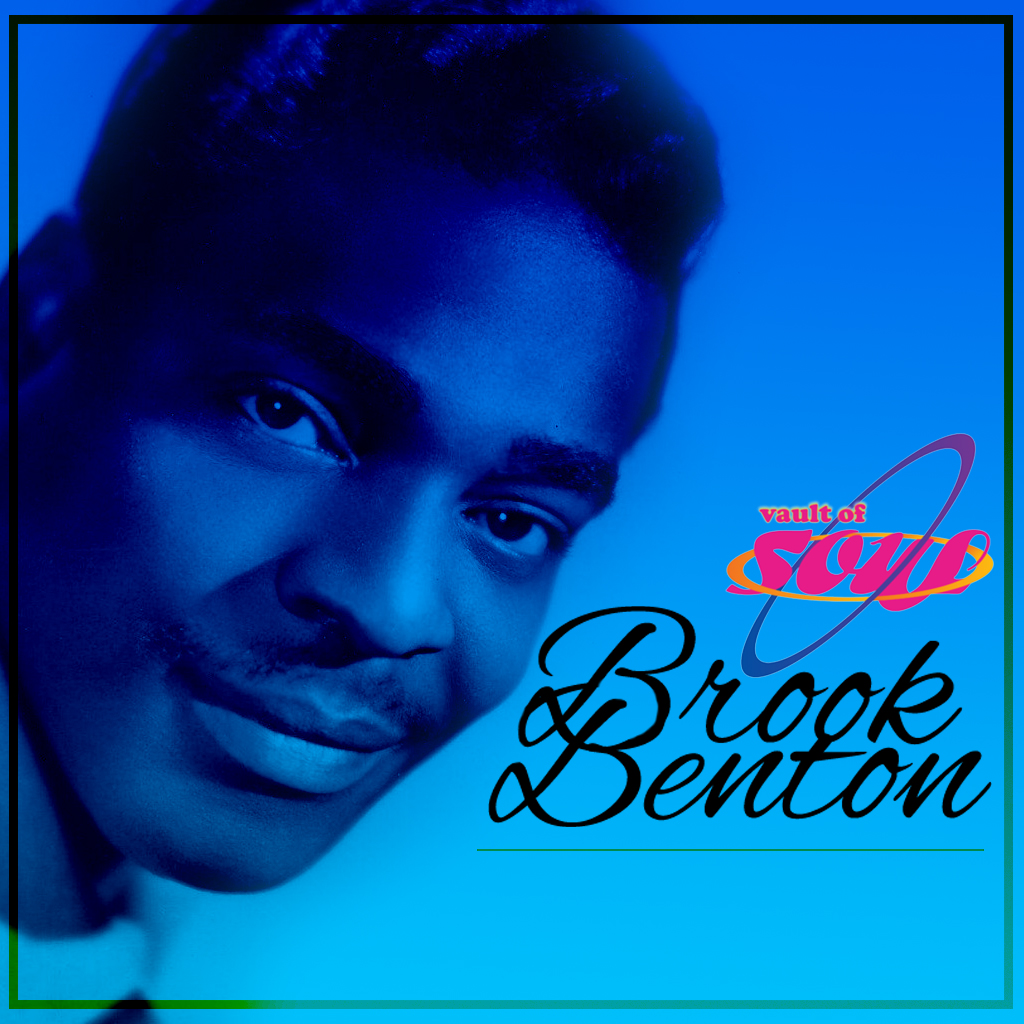
Each week of June, we open the 88.9 Vault of Soul with profiles of iconic soul pioneers. To start 2026’s June coverage, WERS recognizes Brook Benton, one of the pioneer voices in the American Jazz and R&B scene throughout the 50s and 60s.
Biography
Church Roots
Before there could be a Charley Pride or an Elvis Presley, there was Brook Benton. On September 19, 1931, Benjamin Franklin Peay, the boy who in his adulthood would be known as Brook Benton was born in South Carolina. Being born Black in the South, I can attest to the fact that almost everyone at some point in time had a meaningful interaction with the Black church. Benton was no different. Being born into a family where his father Willie Peay was the choir master of their local church, Benton, from a young age was engrossed with singing and songwriting. At just 17, the young Benton moved to New York to pursue those same musical dreams that started in the church. Not too long after arriving, Benton, still using his legal name of Benjamin Franklin Peay, joined The Sandmen.
The Sandmen
Shortly after joining, Benton and the Sandmen signed to Okeh Records, a record label a part of the Columbia Records group. Just days after signing for Okeh, the group recorded three songs in their New York studio, “When I Grow Too Old to Dream,” “I Could Have Told You,” and “Somebody to Love.” All three of these songs featured our man Brook Benton as the lead singer. In 1955, radio stations and record labels would split their artists into separate categories based on genre, race, and whether or not they thought that they would be able to cross the boundary between R&B and pop, or White and Black. The Sandmen along with other artists were placed onto Okeh by Columbia, because they did not believe that they had much crossover value.
Following the release of those three songs, the Sandmen began touring around the New York and New Jersey area. One of their members, Bill Cook, being from New Jersey meant that they got more gigs there than anywhere else. For months, they backed up other artists on the road and in the studio as well, with Benton emerging as one of the biggest draws of the band.
As other members of the Sandmen wanted to record more music as a group, the label wanted to go a different direction. They viewed Benton as the clear attraction of the group. Benton’s name began appearing on the cover of Sandmen records and posters, despite not being the only one in the group. His soon to be trademark smooth, velvet baritone voice made Okeh and Columbia want to turn Benton into a solo act.
Solo Act
In 1956, Benton began his trek into being a solo artist. Initially signed to Okeh, Benton only broke into the charts one time in 1957. After switching to the RCA Victor label, Benton charted with his 1957 hit, “A Million Miles From Nowhere,” Benton charted at #82 in the Top 100s. However, this was the peak of his success singing wise at RCA. Benton still found success behind the scenes as well. By this stage in his career, Benton was a burgeoning songwriter. He writes for names such as Clyde McPhatter and the legendary Nat King Cole. The remainder of Benton’s time on the RCA record was spent mostly behind the scenes, as the label was reluctant to continue pushing him on his own. This led to 1958, where Benton decided to switch to Mercury, a label where he finally started to see success.
On the RCA label, his breakthrough single “It’s Just A Matter of Time,”—a fitting title—propelled Benton into the Billboard Top 100, charting at No. 3. His other single, “Endlessly” made it to No. 12 on the charts, cementing Benton as an artist to be on the lookout for. In 1959, he released his debut album, the self-titled Brook Benton. Benton seemingly had found success with songs that fit his baritone style better than other artists. In fact, initially his early releases were all written for Nat King Cole as the intended performer. To put a punctuation on the most successful period of his career, Benton wrote “A Rockin’ Good Way (to Mess Around and Fall in Love)” in 1960 to be sung as a duet with Dinah Washington. The song peaked at No. 7 on the Billboard 100 as another sign of Benton’s mastery of music. Towards the mid 60s, the velvet singer’s positions on the charts began to dip more and more.
After staying in the background for majority of the 60s, Benton bursted back onto the scene with Atlantic Records. With his legendary “Rainy Night In Georgia.” The baritone legend was back. He would go on to release five albums with Atlantic. Into the 70s and 80s, Benton would continue to release music with some success here and there. Unfortunately, in 1988 Benton would pass away from pneumonia.
Who Inspired Brook Benton
- Church Gospel Music
- Nat King Cole
- Billy Eckstine
- Clyde McPhatter
Who Was Inspired by Brook Benton
- Charley Pride
- Elvis Presley
- Gene Vincent
- Eiichiro Oda
Spotlight Tracks
“It’s Just A Matter of Time” (1959)
One of the first things that strikes you when you listen to “It’s Just A Matter of Time” is the dreamlike instrumental in the background. Then, while you are entranced by that, the smooth baritone voice of Brook Benton takes over all of your senses. This song is just as beautiful lyrically as it is composition wise. Benton makes love feel how it should, sweet;. There are points where he pitches his voice lower to give a heightened gravity to his words. What Benton does on “It’s Just A Matter of Time” is create a true soundscape, where you get lost in every aspect of the song.
“Endlessly” (1959)
Just like in “It’s Just A Matter of Time,” Benton employs strings to add a swell of emotion to the beginning of “Endlessly.” His voice, unlike on the last song, has this sense of urgency to it. It conveys a feeling of the childlike joy that love can entail. His voice stays in the high and cheerful, as on this song, he already has his love and is not waiting for it. To me, there is also a hint of inspiration from older Western music. It feels like this would be played under a sweeping landscape shot in a film.
“A Rainy Night in Georgia” (1970)
On “A Rainy Night in Georgia,” we get a more mature Benton. This can be heard in his voice, but also the composition of the song. He takes a much more somber approach to his vocals, and the strings this time instead of being bright are darker and quieter to convey that somber feeling. He says that his sorrow is so great that it exists all over the world. In his maturity in this song, Benton becomes more soulful and his voice even more subtly powerful while still remaining hushed.